Appearance ideals and diet culture influence so much of the world we live in, we’re bound to encounter ‘diet talk’ from time to time. ‘Diet talk’ can include comments or jokes about:
- eating and food choices;
- body weight, shape or size; or
- movement and exercise habits.
If you’ve been impacted by an eating disorder, diet talk might feel extra challenging.
Because we’re so surrounded by diet culture, sometimes people make hurtful or uncomfortable comments without even realising. It can help to come from a place of assuming best intentions.
We can’t control how others act and speak, but we can control how we respond. In this blog post, we go through different sorts of food, body and movement comments people might make – about you, themselves or other people – and ways you might respond.
The person you’re speaking with also makes a difference. For example, what you feel comfortable saying to your best friend will be different to a family member you only see a few times a year, or if you’re in a group setting versus a private conversation.
Also note, this article is about ‘what to say’ but sometimes the best thing you can do is not say anything. It might be what you need to protect yourself, and there’s no shame in that. In fact, learning how to ride through mild discomfort, or actions of others that are out of our control, is also a valuable skill in recovery. Or it might simply be that in that moment, silence speaks louder than words!
How to respond to comments on your eating or food choices
“I wish I could eat that!”
- “You totally can!”
- “Would you like to try some?”
- “We’re here to enjoy this meal together, so lets enjoy it!”
“Is that what you’re eating?”
- “I’m listening to my body.”
- “Yes, and I’m good with it.”
- “Yep.”
- “I’m really proud of how I’ve worked to listen to my body and its needs.”
“You should watch what you eat.”
- “I know in our family we make these comments all the time, but I feel like it’s not the best attitude to food. I want to try something different.”
- “You say you’re saying this out of care for my health, but it would be more helpful if you could support me to make my own eating choices.”
- “I’m not sure what makes you think that’s a kind thing to say – I’m going to let you try again.”
How to respond to comments on your body
“I wish I could look like that!”
- “I think you mean that as a compliment, but I’d rather not have the focus be on my body.”
- “I like who you are!”
“Have you lost/gained weight?”
- “I’m not sure, I’m trying to not pay attention to that.”
- “Why does that matter?”
- “That’s a pretty personal question – you might not be thinking about this, but people’s bodies can change for all sorts of reasons.”
How to respond to exercise and fitness chat
If they ask questions or comment on your movement habits or choices
- “There are so many different ways to move my body, so I’m going to pick the way that brings me joy!”
- “I like to focus on how my body feels when I move.”
- Using the question to pivot: “Oh that reminds me, how is your [non-exercise related hobby] going?”
- “Rest days are important too.”
Conversations about tracking and metrics
Talking about specific metrics in sport and fitness spaces is very normalised by diet culture. However, for people at risk of or already experiencing an eating disorder, this can be really challenging.
This could include comments like the specific kilometre distance a person ran on their run or swam at the pool this weekend, step counts, the exact weight they can bench in the gym, or ‘personal best’ metrics.
You might also encounter chat about tracking food intake, like counting calories or macros.
Some ways to respond could be:
- “That’s great if it works for you, but I find talking about specific metrics difficult. Do you mind not sharing that with me?”
- “I’m just trying to focus on how my body feels when I walk / run / swim / play / lift weights / etc.”
- “I feel like my body tells me when I need to refuel or hydrate, so I’m just trying to listen to that.”
- “I’m not into counting calories – I’m focusing on the nourishment and joy that food brings.”
How to respond to comments on the bodies or behaviours of others
If the person is there
Don’t be a bystander. You could change the topic, or shift the focus to something else about them.
- “Did you see the painting Robyn did recently?”
- “I’m so proud of Mark, he just got a great result on his history assignment. Mark, what was the topic again?”
Comments on the food choices of others
- “That’s their choice.”
- “That’s their business.”
- “I don’t want to make assumptions about someone else’s food choices.”
Comments on someone else’s body
- “I wonder how we’d feel if we tried not to focus on the size of our bodies?”
- “I wonder if we try and avoid commenting on other people’s bodies?”
- “People can look how they look, and that’s ok!”
If they bring someone’s body or appearance into a conversation about who they are or something they did
- “I don’t see how that’s relevant; people’s bodies are morally neutral.”
- “I know she upset you, but that we don’t have to bring her body into it.”
- “I’d rather not talk about this, it feels unkind.”
How to respond when someone makes self-deprecating remarks
Sometimes the hardest comments to hear can be those people make about themselves.
Some common ones many of us have heard include: “I feel so fat,” “I hate how I look,” “I hate my [body part],” “I look awful in this outfit,” or “that’s such an ugly photo of me.”
No one wants to hear someone they love talking negatively about themselves. Your instinct might be to quickly try to dismiss the comment – “no you don’t!” or “I think you look great!” – but this can feel like you’re dismissing their feelings. You might also be tempted to join in and make negative comments about yourself, but that’s not helpful – for either of you.
Instead, try to neutrally validate what they’re feeling:
- “I’ve noticed when I feel like that, it’s because there’s something else making me feel stressed or upset. Is there something going on for you that you want to talk about?”
- “I can see you’re feeling upset about this. Is there something that would make you feel more comfortable?”
- “I know, it can feel so hard to be kind to yourself – and even finding it hard, can make you harder on yourself! I find it helps to just try to accept that this is how I feel right now.”
- “I get it, the pressure to look a certain way is exhausting. I find it helps me to think about what my body allows me to do, even if I don’t ‘like’ every part of it or how it looks.”
- “I’m sorry to hear you feel that way, that is really hard. We’re all doing our best to feel good in our own skin.”
How to respond to eating disorder jokes
Sometimes people joke about eating disorders in themselves or others. For example: “I think Sally has an eating disorder!” or, “the way I’ve been eating, I reckon I have an eating disorder.”
Sometimes people do this because they don’t understand mental health conditions are not something to joke about. Other times, people might use a lighthearted comment to ‘test the waters’ about something they’re actually concerned about.
In either case, a good approach is simply to take them seriously. If they are ‘joking-but-serious’, this gives them permission to explore their concern, whether that’s in the moment with you or later on. If they’re just having a laugh, taking it seriously shows them it’s not funny.
You can decide if you would like to open further conversation – for example: “Thanks for telling me, what makes you say that? / would you like to talk more about that?”
Or if you want to just keep it brief and move things along, try: “Really? If you’re worried, there are some great resources out there – it’s never too early or too late to [ask for help / try to help].”
If you make a diet, weight or body comment
As we’ve said above, diet culture can get us all! We are taught from when we’re very young to believe in diet culture, and unlearning it is an ongoing process – we all slip up. Sometimes you don’t even realise until you’ve already made a comment, or seen its impact on someone, that maybe you shouldn’t have said that.
Whether it’s something you’ve said about yourself or someone else, try to show yourself grace. Acknowledge your mistake, and then move on. You could try:
- “Sorry, I just spoke without thinking – I don’t actually mean that / think that.”
- “Yikes, that was an intrusive thought – sorry!”
- “I actually regret saying [comment] earlier, I’m sorry.”
- “Sorry, that was a brain fade from me, I shouldn’t have joked about that.”
- “I just realised saying that about myself could be hard to hear – let me try again.”
If you find that ‘diet talk’ feels very distressing, or makes you feel upset for a prolonged period, it can help to talk to someone. The EDV Hub is here to listen: 1300 550 236.
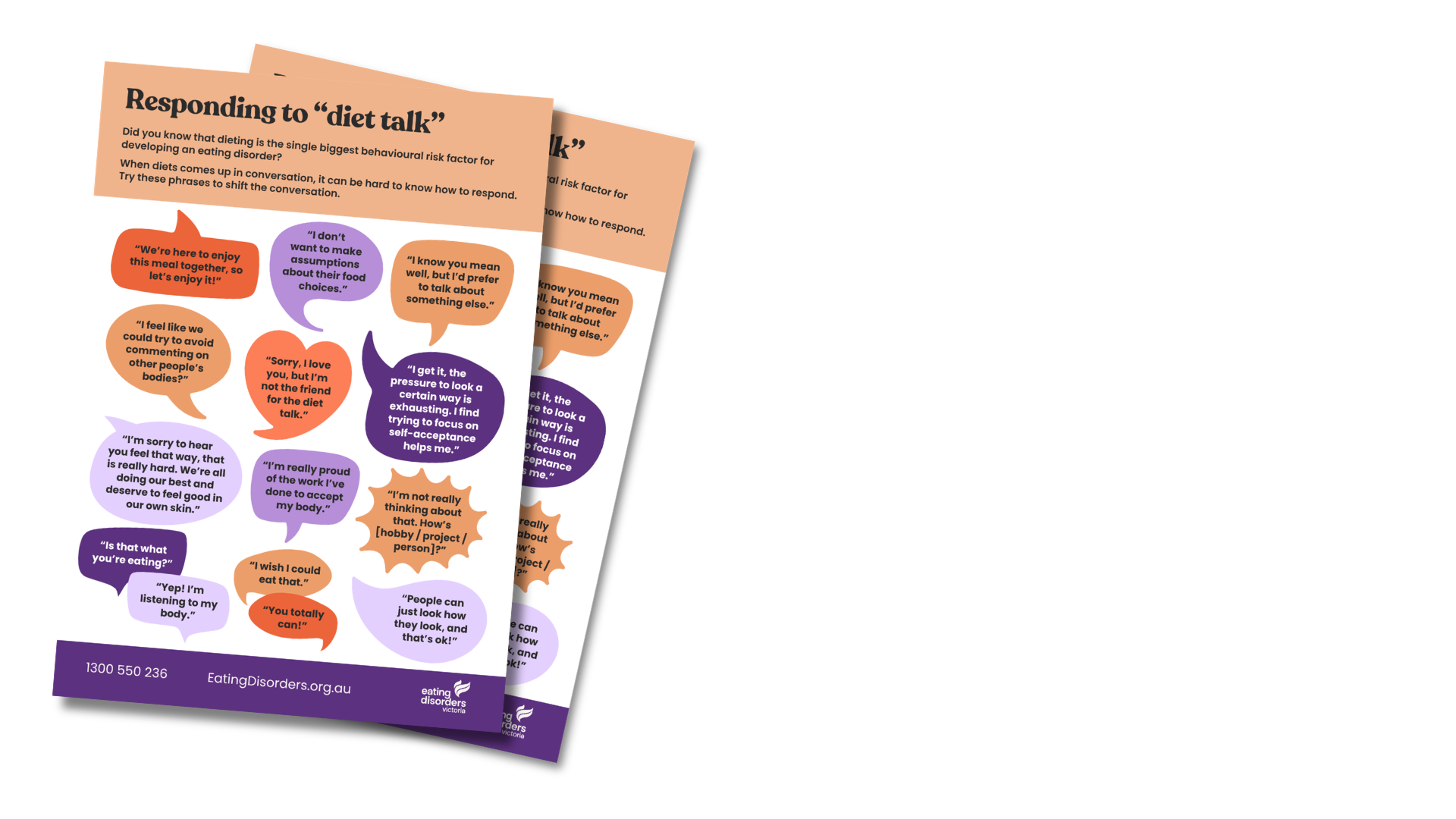 Poster download: Responding to diet talk